
Rot13
ROT13 replaces each letter with the one 13 places further along the alphabet, so A becomes N and N becomes A. Because the alphabet has 26 letters, applying ROT13 twice gives back the original — the same button encodes and decodes. Type or paste text to convert it instantly, switch to ROT47 or any Caesar shift, or show all 25 shifts at once to crack an unknown Caesar cipher.
- Free to use
- No sign-up
- Runs in your browser
ROT13 / Caesar converter
Secret Code Kit
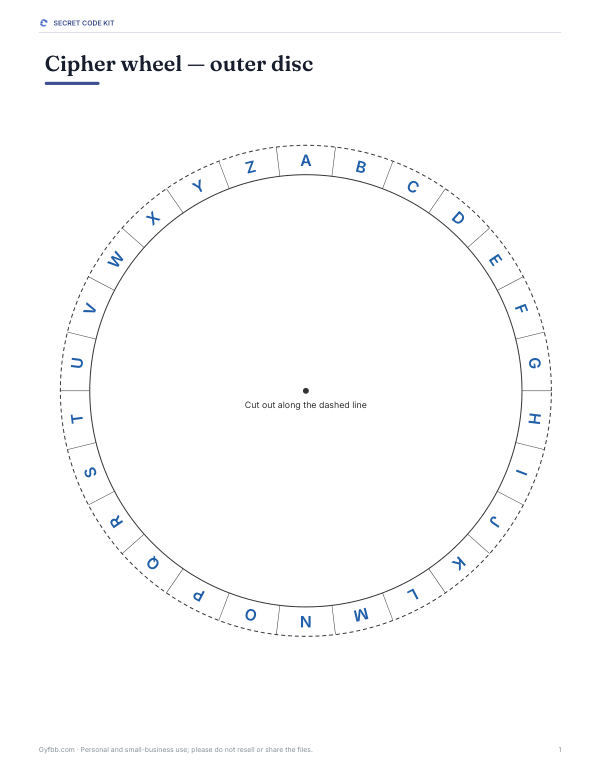
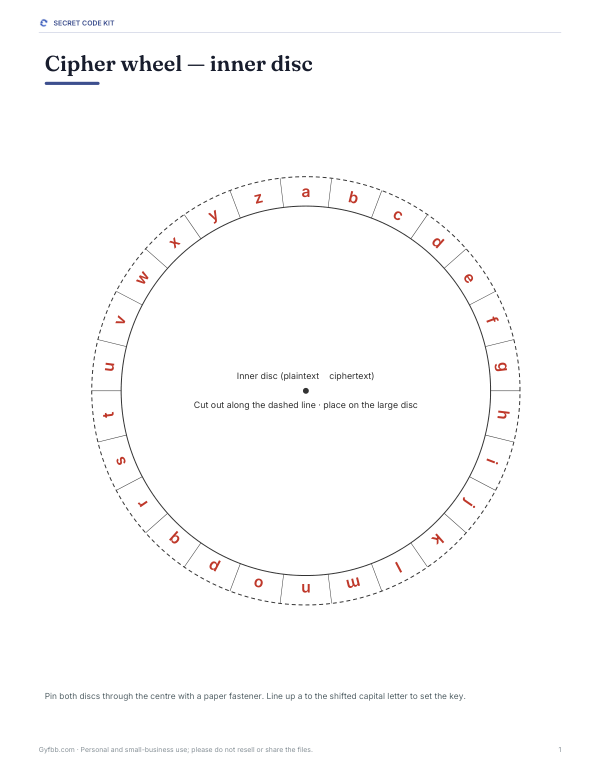
Printable cipher wheel (two discs to cut out), Caesar cipher worksheets with answer keys, a ROT13 reference strip and secret message note templates — ideal for classrooms, clubs and escape rooms.
- Cipher wheel — outer disc (PDF)
- Cipher wheel — inner disc (PDF)
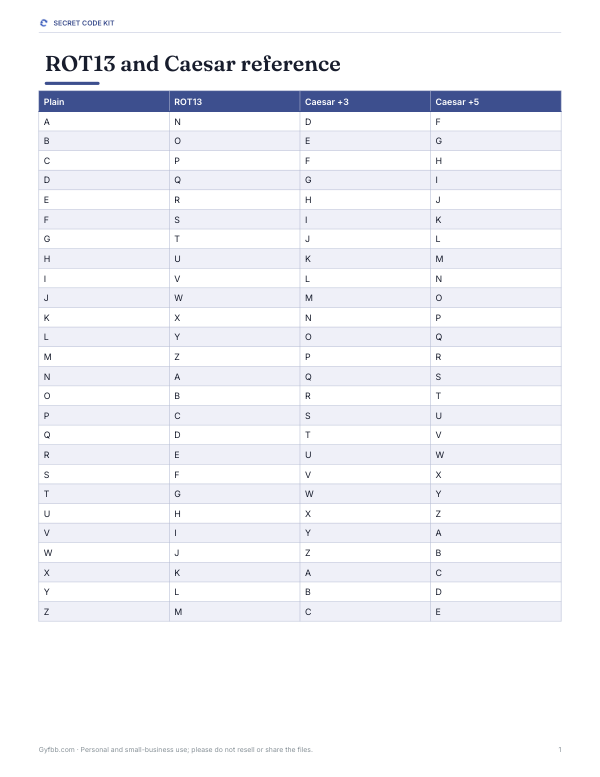
- ROT13 table (PDF)
- Decode worksheet (PDF, DOCX)
- Encode worksheet (PDF, DOCX)
- Message notes (PDF)
Formats: PDF, DOCX. Instant download after payment (link valid 72 hours, up to 5 downloads). AI-assisted: the templates were drafted with AI help and reviewed and laid out before publishing.
$3.00 USD, one-time 6 files · about $0.50 each
- Instant download
- 7-day refund
- Secure checkout by Stripe
7-day money-back guarantee. Full refund within 7 days of purchase, even after you download.
Free sample: Caesar Decode Worksheet (PDF, 64 KB)
Full refund within 7 days — see the refund policy and license.
Free printables
Single sheets you can print right now, no sign-up. The full pack adds every sheet in one download plus the editable files.
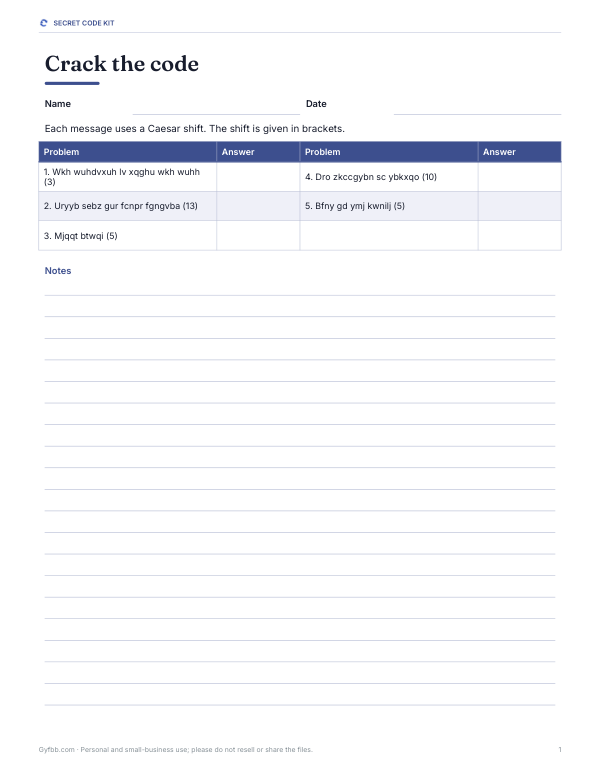 Printable Rot13 Decode Worksheet
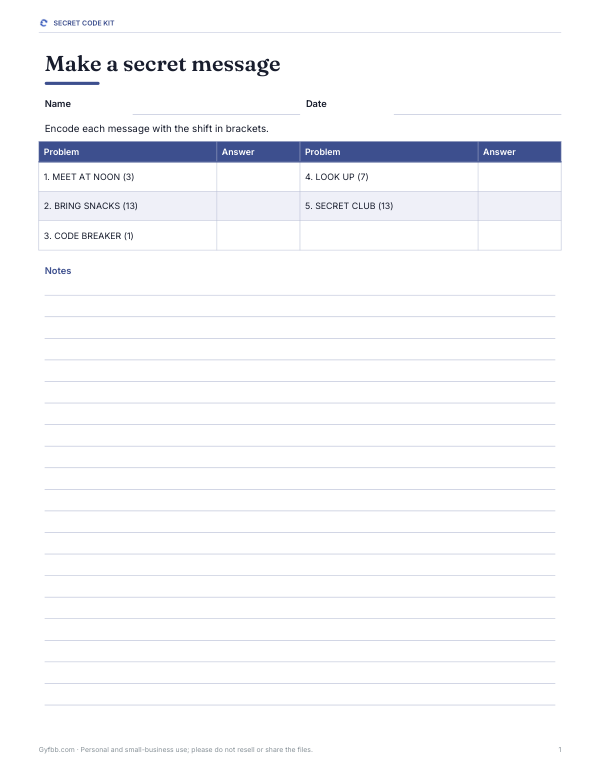 Printable Rot13 Encode Worksheet
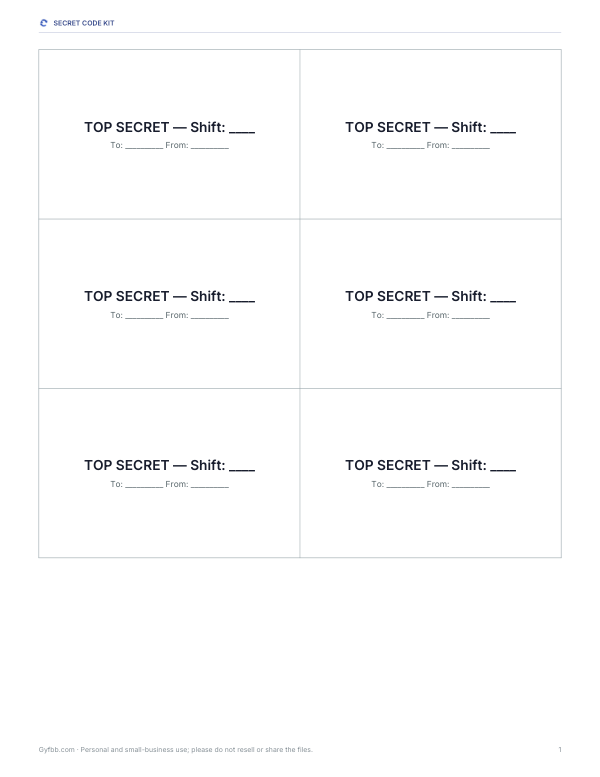 Printable Rot13 Message Notes
How ROT13 works
| Plain | A | B | C | D | E | F | G | H | I | J | K | L | M |
|---|---|---|---|---|---|---|---|---|---|---|---|---|---|
| ROT13 | N | O | P | Q | R | S | T | U | V | W | X | Y | Z |
Each letter is swapped with the letter 13 positions away, wrapping around from Z back to A. The first half of the alphabet maps to the second half and vice versa, which is why ROT13 is its own inverse. Case is kept, and digits, spaces and punctuation are left unchanged. “Hello” becomes “Uryyb”, and “Uryyb” becomes “Hello” again.
ROT13 is not encryption
ROT13 hides text from a casual glance but offers no security at all: anyone can reverse it instantly, and there is no key. It is used for things like hiding spoilers, puzzle answers and punchlines in forums, obscuring offensive jokes so readers choose to see them, and in programming exercises. Never use ROT13, ROT47 or a Caesar shift to protect passwords, personal data or anything confidential — use proper encryption instead.
The ROT family
| Method | What changes | Self-inverse? |
|---|---|---|
| ROT13 | Letters A–Z, a–z, shifted by 13 | Yes |
| ROT5 | Digits 0–9, shifted by 5 | Yes |
| ROT18 | ROT13 on letters plus ROT5 on digits | Yes |
| ROT47 | All visible ASCII characters from ! to ~, shifted by 47 in a 94-character set | Yes |
| Caesar shift n | Letters shifted by n (1–25) | Only when n = 13 |
Caesar ciphers and how to crack them
ROT13 is a special case of the Caesar cipher, named after Julius Caesar, who is said to have used a shift of three. A Caesar cipher only has 25 possible keys, so it can be broken simply by trying them all — a “brute-force” attack. Press “Show all 25 Caesar shifts” and the tool lists every possibility and highlights the one that contains the most common English words. For longer messages, letter frequency also gives it away: E, T and A are the most common letters in English.
How to use the converter
- Choose ROT13 for the classic swap, or another method.
- Type or paste text in the input box — the output updates as you type.
- For a Caesar shift, set the shift and choose encode or decode.
- Use “Swap output into input” to apply the method again, or to chain methods.
- Copy the output, or show all shifts to crack an unknown Caesar message.
Worked example
The sample input asks a riddle and gives the answer in ROT13: “Gb trg gb gur bgure fvqr!”. With ROT13 selected the output reads “Jul qvq gur puvpxra pebff gur ebnq? To get to the other side!” — the question becomes scrambled and the answer becomes readable, showing that the same operation both encodes and decodes. Pressing the brute-force button with the answer text highlights shift 13.
A short history
Substitution ciphers are ancient. The Roman historian Suetonius described Julius Caesar using a shift of three to protect military messages, and Augustus reportedly used a shift of one. Monoalphabetic ciphers like these were eventually broken by frequency analysis, first described by the Arab scholar al-Kindi in the ninth century. ROT13 itself became popular in the early 1980s on Usenet newsgroups, where posters used it to hide spoilers and punchlines so readers had to choose to decode them.
Programming ROT13
ROT13 is a classic beginner programming exercise. In Python, the codecs module includes it directly: codecs.encode(text, "rot_13"). On Unix-like systems, the tr command does it in one line: tr "A-Za-z" "N-ZA-Mn-za-m". The core idea in any language is the same: for each letter, find its position in the alphabet, add 13, wrap around modulo 26 and keep the original case.
Letter frequency in English
| Rank | Letter | Approximate share of letters |
|---|---|---|
| 1 | E | about 12% |
| 2 | T | about 9% |
| 3 | A | about 8% |
| 4 | O | about 7.5% |
| 5 | I | about 7% |
| 6 | N | about 7% |
In a Caesar-shifted English message, the most common letter usually stands for E. Work out how far it has moved and you have the key.
Fun uses
- Hide puzzle solutions and quiz answers.
- Write secret notes with children and decode them with the printable cipher wheel.
- Create escape-room clues with Caesar shifts.
- Teach the basics of cryptography and why modern encryption needs keys.
- Spot ROT13 in the wild: some old newsgroup posts and software easter eggs use it.
Privacy
All conversion happens in your browser. Nothing you type is sent or stored.
Frequently asked questions
How do I decode ROT13?
Apply ROT13 again — it is its own inverse.
Is ROT13 secure?
No, it is trivial to reverse and should never protect sensitive information.
What is ROT47?
A variant that rotates all printable ASCII characters from ! to ~ by 47.
What is the difference between ROT13 and a Caesar cipher?
ROT13 is a Caesar cipher with a shift of 13.
How do I crack a Caesar cipher?
Try all 25 shifts — the tool shows them and highlights the most likely one.
Are numbers changed by ROT13?
No, only letters. Use ROT5 or ROT18 to change digits.
Can ROT13 handle accented letters?
No, only the 26 basic Latin letters are shifted; other characters are left as they are.
What does ROT stand for?
Rotate — each letter is rotated a fixed number of places around the alphabet.
Can I use my own shift?
Yes, choose Caesar shift and set any value from 1 to 25.
Why is ROT13 used for spoilers?
It makes text unreadable at a glance but anyone who wants to can decode it instantly.
Is my text uploaded?
No, it stays in your browser.